
Chapter 6 Scattering
6.1 Introduction
Nuclear scattering experiments are fundamental tools in nuclear and particle physics. They provide invaluable insights into the properties and behaviors of nuclei, as well as the forces and particles that govern them. They are useful for many reasons, including:
- Probing the Structure of the Nucleus
-
Scattering experiments can be used to study the size, shape, and internal structure of nuclei. By analyzing how particles scatter off a nucleus, we can determine properties like the nuclear radius, charge distribution, and density profile.
- Studying Nuclear Reactions
-
Scattering experiments can help us understand the processes that occur when two nuclei collide. This includes various types of fusion and fission reactions.
- Understanding the Strong Force
-
Scattering experiments help us probe the strong nuclear force, responsible for holding the protons and neutrons together within a nucleus.
- Study of Spin and Angular Momentum
-
Scattering experiments can provide information about the spin states and angular momentum of nuclei.
6.2 Scattering cross-section
One of the ways we can explore the properties of the nucleus is to perform a scattering experiment. We direct a beam of particles at our target and examine the interactions between a nucleus and an incident particle. The total scattering cross-section is the sum of elastic and inelastic processes:
| (6.1) |
Definition 6.2.1 (Elastic Scattering).
Involves those processes where incident particles are deflected from their initial directions but do not lose energy.
Definition 6.2.2 (Inelastic Scattering).
Involves those processes in which energy loss occurs.
The total interaction cross-section can also include absorption of the incident particles:
| (6.2) |
6.2.1 Flux
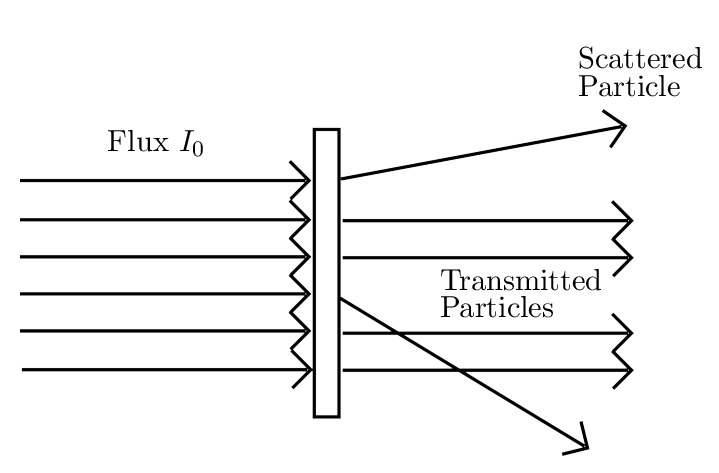
Consider a parallel beam of sub-atomic particles (protons, neutrons, -particles etc.) incident on a target. The flux of the incident beam is the number of incident particles per unit time crossing unit area oriented perpendicular to the beam direction. A uniform flux implies particles are uniformly distributed throughout the beam.
6.2.2 Attenuation of the intensity of particle beam passing through matter
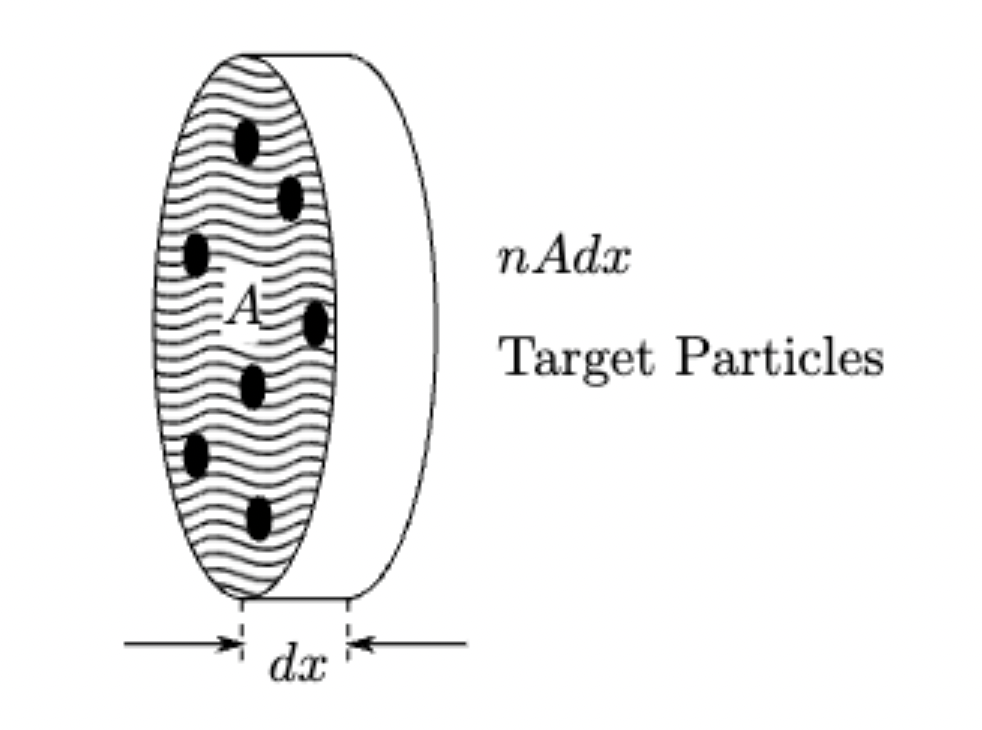
Imagine the scattering through a thin target, as shown in Fig. 6.2. We can write
| (6.3) |
or
| (6.4) |
where is the flux of particles that have undergone interaction with a set of target particles, each having a cross-section , as we pass an infinitesimal distance through the target. is the number of target particles per unit volume. The solution to this equation is
| (6.5) |
where is the incident flux. Note the similarity with radioactive decay. The number of particles that have undergone interaction is therefore
| (6.6) |
Careful 6.2.1.
Be careful with the difference between number density per unit area, and number density per unit volume. I will generally denote these by and respectively. You should always check the units are consistent, i.e. and and are dimensionless.
Example 6.2.1 (Attenuation).
A nuclear pile contains Cadmium (Cd) control rods with a density of , and a neutron absorption cross-section of . What fraction of neutrons are absorbed when passing through of the control rod?
[The atomic mass of Cd is , where .]
Solution.
The number density of Cd is
| (6.7) |
Absorption fraction is
| (6.8) |
6.3 Differential and total cross sections
The scattering cross-section measures the probability that a particle is scattered from a beam incident upon a target. However it gives no information about the direction of scattered particles. Why is this important?
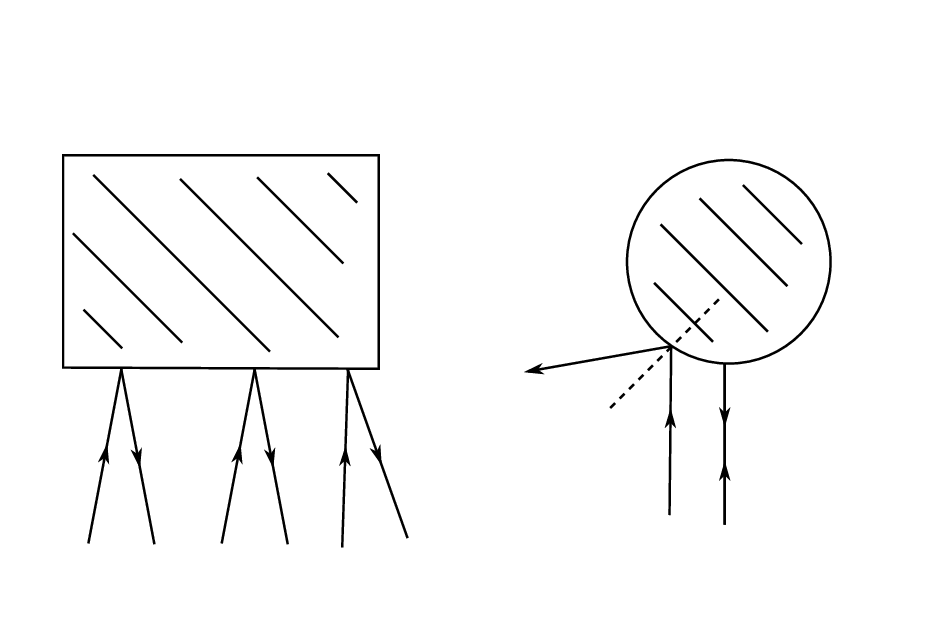
The angular distribution of the scattered particles provides information about the shape of the scattering centre (see Fig. 6.3). In nuclear scattering it is the shape of the potential we explore. We visualise our cross-section as a geometric disc, bearing in mind that the cross-section isn’t really a physical area, but a measure of probability. Consider just those particles scattered into an infinitesimal element of solid angle centred around the angles and . We imagine them as originating from an element of our disc , as shown in Fig. 6.4.

The fraction of particles in the beam scattered into a solid angle around the direction () for a target with scatterers per unit volume and a target thickness is given by
| (6.9) | ||||
where is the incident flux and is called the differential scattering cross-section.
The differential scattering cross-section can be a function of the scattering angle; the probability that a particle be scattered in a particular direction need not necessarily be uniform. The relationship between the differential and total scattering cross-sections is a simple one:
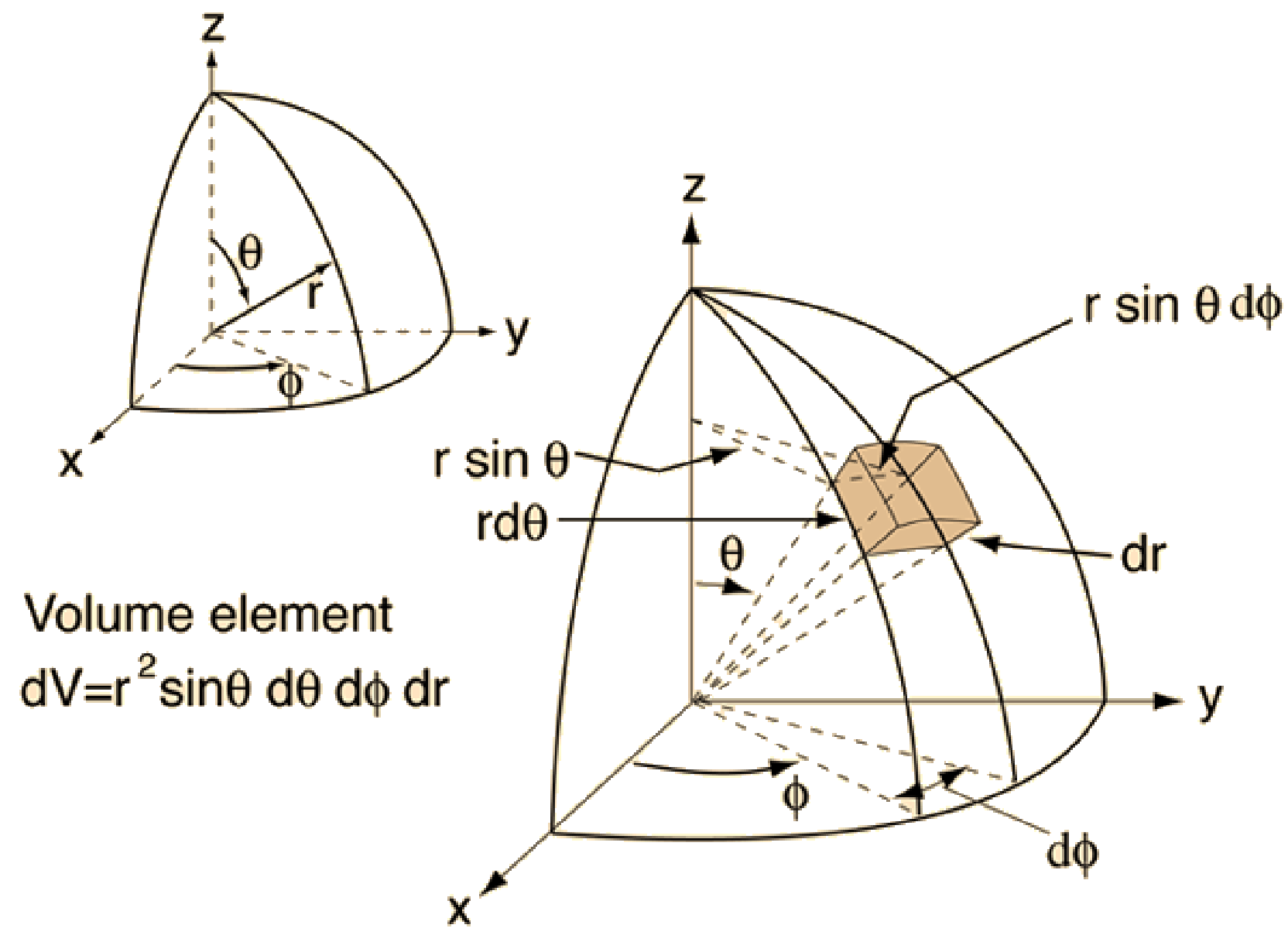
Background 6.3.1 (Spherical coordinates).
In spherical polar coordinates (see Fig. 6.5) the Cartesian coordinates are given by
| (6.10) | |||||
| (6.11) | |||||
| (6.12) |
where and . The volume element is
| (6.14) |
The solid angle, , measured in steradians, can be written in terms of the differential quantity
| (6.15) |
so the solid angle is equal to
| (6.16) |
where is the surface.
| (6.17) | ||||
where I have removed the argument () for the differential cross-section. Can we differentiate between the total cross-sections for scattering and absorption?
We obtain the total interaction cross-section, , from the attenuation of the beam as it passes through a target (provided we know the target thickness and number of atoms per unit volume) from the decay law (Eqn 6.5). The total scattering cross-section, , can be measured by detecting all the particles scattered out of the beam direction – in other words by integrating over the differential scattering cross-section (Eqn 6.17). We can do this by measuring the scattered flux over all angles with a detector with a small aperture, or we can use a detector designed to surround the sample at all angles except that associated with free passage of beam. In both cases the detector should be placed far from the target.
6.4 Classical scattering and the impact parameter
Consider a centrally symmetric potential, in other words one which depends on the distance that a particle is from the centre of the potential. For convenience we take the centre of the potential as the centre of the coordinate system, as shown in Fig. 6.6.

A beam of particles is incident on a centro symmetric potential. The incident beam is in the direction so the differential scattering cross-section will be a function of but not . If there were no interaction between scattering centre and particle, the particle would pass by the scatterer at a distance . This is known as the impact parameter and is a very useful concept in classical scattering problems.

All those particles with impact parameters between and with azimuthal angles between and will be scattered into a solid angle centered around the direction (). (This could be associated with a detector to count the scattered particles.) What fraction of incident particles fall in the shaded area? For a sample of thickness , with nuclei per unit volume:
| (6.18) |
For a single nucleus, we don’t need the term, this just includes all nuclei in unit area of our target. This is equal to the probability that the particle is scattered into the infinitesimal region of solid angle about .
| (6.19) | |||
The modulus sign around ensures that the differential scattering cross-section is always positive, as is sometimes negative. For a given form of potential , depends on in a certain way. The opposite is also true.
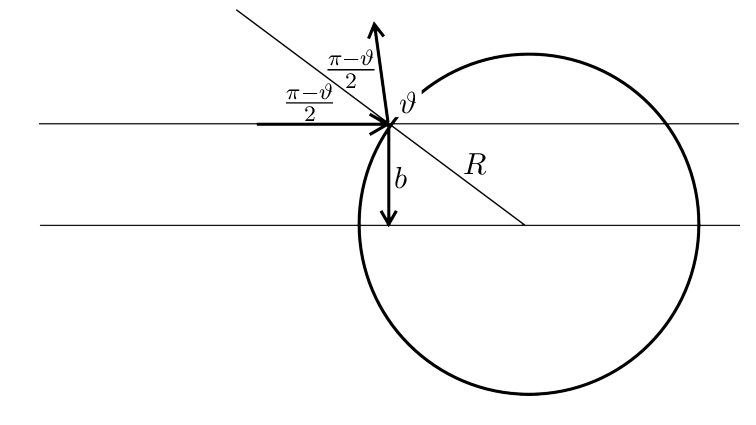
Example 6.4.1 (Hard Sphere Scattering).
Determine the differential and total scattering cross-section of a hard sphere of radius , as shown in Fig. 6.8.
Solution.
The impact parameter is
| (6.20) |
so that
| (6.21) |
The differential scattering cross-section is
| (6.22) | |||
is isotropic, i.e. independent of and .
The total cross sections is given by
| (6.23) |
NB: this is the area of a circle, as expected.
6.4.1 Examples of scattering
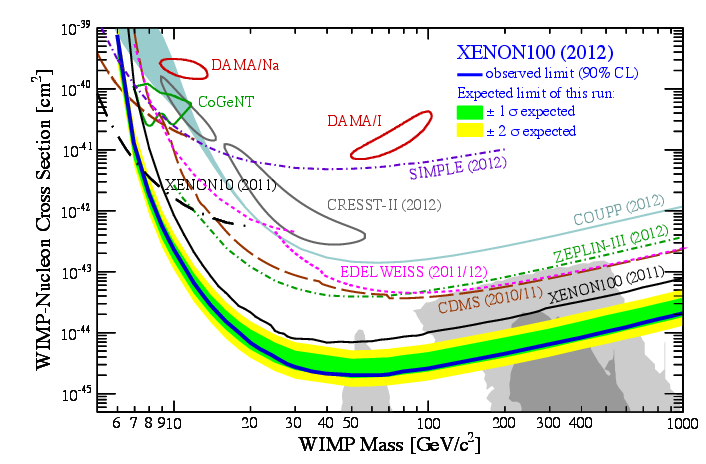
An example of a process with a very small scattering cross-section is Weakly Interacting Massive Particle (WIMP) - nucleon scattering. WIMPs are the leading candidate for dark matter and arise naturally in theories beyond the Standard Model of particle physics, such as supersymmetry. Here the scattering cross-section is constrained by experiments to be tiny, around b, as shown in Fig. 6.9, well below the actual geometric area of the nucleus.
A further example is the Rutherford differential scattering cross-section, which will be discussed further in the next lecture.
Example 6.4.2 (Rutherford Scattering).
In the Rutherford description of particle scattering, the relationship between and is
| (6.24) |
where is the atomic number of the target nucleus and the kinetic energy of the particles. Derive an expression for the differential scattering cross-section, and for the fraction of particles incident on a metal foil, with atoms per unit volume and thickness , that are scattered into a solid angle at scattering angle .
50 MeV particles are incident normally on a thin sheet of gold, , of thickness m. Determine the fraction of particles scattered into a detector of area placed 0.1 m from the target at a scattering angle of 90 degrees.
The density of gold is and 1 atomic mass unit is .
Solution.
| (6.25) | |||||
| (6.26) | |||||
| (6.27) |
The fraction scattered at 90 degrees is
| (6.28) |
The solid angle is st. The number density is . Plugging in the numbers the fraction is
| (6.29) |